Showing posts with label Gerrard. Show all posts

Friday, November 16, 2012

International Caps and Historical Facts!


In Britain 'caps' are awarded to players making international appearances for England, Scotland, Wales and Northern Ireland. It is a tradition dating back to the origins of the Football League in the Victorian age, when during games players routinely wore caps denoting club colours. The concept of each team wearing a set of matching shirts had not been universally adopted.
When the first international match took place in 1872 players wore caps, as was the norm. When outfield players ceased to wear caps some years later, representing one's country at football continued to be marked by the symbolic presentation of a cap.
The first caps were awarded to the players who participated in the Scotland v England international on 31st March 1886 in Glasgow.

Peter Shilton is the most capped England player of all time. The goalkeeper holds the record after playing 125 games for his country, including fifteen as captain. His last appearance was at the 1990 World Cup finals in Italy.
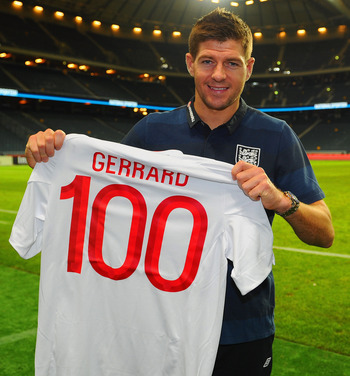
Six England players are centurions with 100 caps or more. As well as Shilton they are Bobby Moore, Bobby Charlton, Billy Wright, David Beckham and most recently Steven Gerrard (right).

Of Billy Wright's 105 appearances for England, he captained the side on 91 occasions.

Ahmed Hassan (born 2 May 1975 in Maghagha, Egypt) is the most capped international male footballer in history with 184 appearances for Egypt.

On 30th May 2006, Theo Walcott became the youngest player to make his England debut, when he came on as a substitute against Hungary at the age of 17 years and 75 days.

The youngest player to be awarded a cap for Wales is Gareth Bale, (then of Southampton), who on 27th May 2006, aged 16 years and 315 days appeared as a substitute against Trinidad & Tobago.

The youngest British player ever to be awarded a full cap is Norman Whiteside who was 17 years and 41 days old when he made his debut for Northern Ireland against Yugoslavia on 17th June 1982 at the World Cup finals. He still holds the record as the youngest player to take part in a World Cup final tournament.

The oldest player to participate in a World Cup finals tournament was Cameroon's Roger Milla, who was 42 years and 39 days at the 1994 finals held in the USA. Cameroon were knocked out in the group stages, however Milla (right) scored a goal against Russia, setting a record as the oldest goalscorer in a World Cup finals match.

The oldest player to receive his first England cap is Alexander Morten, a goalkeeper with Crystal Palace, who was 41 years and 113 days old when he kept goal against Scotland on 6th March 1873.

The oldest player to have been capped by England is Sir Stanley Matthews, who was 42 years and 103 days old when he played against Denmark on 15th May 1957.

Jack Cock (Huddersfield Town) was the first Cornishman to be capped for England in 1920. Cock went on to become a popular variety star and also appeared in a number of British films.

The first Fourth Division player to win an international cap was Vic Rouse (Crystal Palace) for Wales against N.Ireland in 1959.
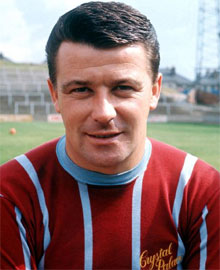
Johnny Byrne (right) won his first cap for England in 1962, while paying for Crystal Palace in the Third Division. Tommy Lawton (Notts County), Reg Matthews (Coventry), Peter Taylor (Crystal Palace) and Steve Bull (Wolves) also gained England caps while playing their football in the Third Division.

Cecil Moore (Sheffield Utd) was capped for Norther Ireland in 1949, emigrated to America, and appeared for the USA against England in 1953.

Johnny Carey (Manchester United, 1938-53) won 29 caps for the Republic of Ireland and seven for Northern Ireland.

Kevin Keegan was awarded his first England cap against Wales on 15th November 1972. His second cap was also against Wales (24th January 1973), as was his third (11th May 1974). He remains the only player to have played his first three games for England against the same opposition.

Gary Howlett (Brighton) travelled to the other side of the world to earn his first international cap and played for only 19 minutes. On the 3rd June 1984, Howlett was named as a substitute for the Republic of Ireland against China which was taking place in Sapporo, Japan,. Nineteen minutes from time he came on, but was never chosen to play for the Republic again.

James Milner (right) with 46 appearances and nine goals is the most capped England Under-21 International of all-time.

The only player to win both semi-professional and full caps for England is Steve Guppy. Guppy was chosen for the England semi-professional team while playing for Wycombe Wanderers in the Conference in 1989/90 and in 1999, when at Leicester City, he won his first and only cap for England against Belguim at the Stadium of Light.

Monday, October 8, 2012

The Best Selling Replica Club Shirts in the World


A German sport market research company, has released a very interesting survey on the world’s best selling club football shirts.

Dr Rohlmann’s and his PR Marketing team focused on the sales period 2007/8 to 2011/12 inclusive, in order to have the most accurate overview.

Not suprisingly the survey found that Manchester United and Real Madrid are the two clubs selling the most replica shirts with both United and Madrid averaging 1.4million shirts sales globally each year in the past five years !

As the graphic below shows, Barcelona are No.3 on the sales list (Nike, average 1.15m sales a year) followed by Chelsea in fourth place (adidas, 910,000). The top ten also includes Bayern Munich (adidas), Liverpool (adidas during the research period, now Warrior), Arsenal (Nike), Juventus (Nike), Inter Milan (Nike) and AC Milan (adidas).

Chelsea are the most significant ‘climbers’ since detailed market statistics were last published by this site two years ago. They were adidas’s joint-second best sellers with Liverpool and Bayern Munich two years ago, but have moved clear into second place for adidas – and fourth overall – now!

Dr Rohlmann pointed out that "Oscillations are normal because any sporting success or lack of success drives shirt sales, sometimes up, sometimes down, as does the acquisition or sale of particular stars."
For example, in the case of Chelsea, there was a 2011/12 uplift, undoubtedly as a result of their success in the UEFA Champions League. A second example of this would be at Bayern Munich. Bayern sold between 1million and 1.5million replica kit shirts in 2011/12, when Bayern reached the Champions League final (against Chelsea), which was played in their own stadium in their home city of Munich. A third and final example of success increasing shirt sales could be allied to Olympique Marseille. Their average replica shirt sales over the last five seasons is about 350,000 per year. But if you refer exclusively to the 2009/10 season, when they won the French championship, adidas sold nearly 500,000 replica shirts."

Premier League winners Manchester City sold somewhere just over 250,000, but their five-year average is 175,000 per year – sufficient only to place them 17th in Europe.

However, it is important to remember the results of the survey are based solely on the the volume of replica shirts sold and does not include other official club merchandise, such as training kit, jackets, bags, caps, towels, calenders e.t.c.

If the survey were to include all licensed merchandise sold by football clubs, then Liverpool would be ahead of Real Madrid. Liverpool are adidas’s top-selling team in terms of sales of overall merchandise.

The official Manchester United Investor Relations website says that "over five million items of Manchester United (Nike) branded licensed products were sold in the last year, including over two million Manchester United jerseys." Dr Rohlmann says that for 40 per cent of all United merchandise to be shirts "is extremely high compared to other top European football clubs."

The market research looked in particular at the major European leagues (La Liga, Barclays Premier League, Serie A TIM, Ligue 1 Orange, Bundesliga). However the PR marketing team also looked into big clubs in "less powerful leagues" to assess their value. The conclusion was that no other club in any other European league came close to matching the sales of the top ten listed clubs.

First and foremost, the richest football clubs have the marketing power to create, market and sell their football shirts. Secondly, the power of the domestic league is also a crucial element.

Out of the top 10 teams, four came from the English Premier League: Manchester United, Arsenal, Liverpool and Chelsea, three from Seria A: Inter Milan, AC Milan and Juventus, two from La Liga: FC Barcelona and Real Madrid and one from the Bundesliga: Bayern Munich.

Galatasaray and Fenerbahce, 'the big hitters' of the Turkish Super Lig, both adidas teams, have a huge amount of local and global fans. However their replica shirts sales would amount to a lesser number than the 10th highest ranked club. Another element to consider is the amount of counterfeit clothing products coming out of from Asia and Turkey. This has a very damaging effect on club sales of official merchandise in the less glamorous and affluent leagues.

A 'big' club like Ajax Amsterdam, an adidas club, in a 'small' league like the Dutch Eredivisie league might expect to sell 100,000 shirts and probably fewer in most seasons. Glasgow Celtic, a Nike club are believed to be the biggest sellers among Scotland’s clubs, with 'good year' sales at the lower end of the top 10, ie: several hundred thousand per year, many of them overseas in North America, Canada and Australia. This is still somewhat less than the likes of AC Milan or Inter which sell an average of 350,000 to 425,000 units per calender year.

Source: Dr Peter Rohlmann, www.pr-marketing.org/  and http://www.sportingintelligence.com


When it comes to sporting the name of their favourite Premier League player on the back of a replica shirt, Manchester United striker Wayne Rooney is officially the most popular choice of fans around the world.

Global sales data from Sporting iD, who determined the top five by the number of player names sold for official replica shirts, said it was a close race for the top three positions.

Rooney edged out Liverpool's Steven Gerrard and Chelsea frontman Fernando Torres, Cristiano Ronaldo, formerly with Manchester United and now with Real Madrid, is the fourth most popular over the 20 seasons of the Premier League, with Chelsea's Frank Lampard fifth.

Sporting iD global sales and marketing director Rob Thayne said: "We first started producing Rooney's official player identity in 2002, after he made his professional debut with Everton at the age of 16. We then had to expand that production greatly following his move to Manchester United in the summer of 2004. But Rooney truly went into a league of his own in 2007 when Ruud van Nistelrooy vacated the Manchester United number 10 shirt, and there is a global demand that shows no sign of abating."


Rooney is the first United player to lead the list since Cristiano Ronaldo in the 2007/08 season. But one name could have beaten Rooney to the award. "Had David Beckham remained in the Premier League then the list might have looked different. Certainly his move to Real Madrid in the summer of 2003 triggered record sales of 'Beckham 23' shirts, and before him Eric Cantona was a best seller in the 1990's," said Rob Thayne.

Source: Data supplied by www.sporting-id.com